
1. Introduction: From Aristocratic Beverage to Mass Production
For centuries, the conception and phytochemical utilization of cocoa were strictly linked to its consumption in a liquid state. In the European courts of the 17th and 18th centuries, heirs to traditional Mesoamerican practices, the chocolate beverage differed significantly from contemporary organoleptic standards. It was characterized by being a highly unstable, dense colloidal suspension of marked astringency, with a lipid percentage that hindered its homogenization in aqueous media.
Pre-industrial manufacturing relied on the manual grinding of roasted cotyledons on stone metates heated by direct fire. This rudimentary method broke the cellular structures of the bean, releasing the fat, but it was incapable of reducing the solid particles below the tactile detection threshold of the human tongue. The presence of large aggregates of carbohydrates and proteins, coupled with the flotation of a dense macroscopic layer of cocoa butter on the surface of the cup, required the constant use of molinillos or whisks immediately before ingestion to maintain a temporary emulsion.
Due to the complexity of this artisanal processing and the high cost of complementary inputs such as refined sugar, vanilla, and cinnamon—used to mask the intense bitterness and acidity of poorly fermented beans—chocolate remained indexed as a luxury item exclusive to the aristocracy and upper bourgeoisie. Its use was strongly associated with courtly rituals, therapeutic functions, and demonstrations of socioeconomic status.
The advent of the Industrial Revolution in the 19th century definitively altered this dynamic. The introduction of steam power in roller mills exponentially increased crushing capacity and drastically reduced operation times. However, the true qualitative leap came from the application of mechanical engineering and industrial chemistry applied to the lipidic matrix of cocoa. These developments not only democratized access to the product by lowering the fixed costs of processing, but they also radically transformed the rheology, oxidative stability, and palatability of the food, laying the physical foundations for the phytosanitary and commercial standardization of the global chocolate value chain.
2. The Invention of the Hydraulic Press (1828)
The breaking point from traditional manufacturing toward modern food technology occurred in 1828, the year in which the Dutch chemist and manufacturer Coenraad Johannes Van Houten patented in the Netherlands a disruptive mechanical methodology based on the use of a Hydraulic Press specifically designed for the lipid extraction of masses with high fat content.
The raw material resulting from the intensive grinding of cocoa nibs is cocoa liquor or cocoa paste. From a physicochemical perspective, this liquor is a colloidal dispersion where the continuous phase is constituted by cocoa butter (an intricate system of triacylglycerols that represents between 50% and 55% of the dry weight of the cotyledon) and the dispersed phase is made up of cellular fragments of starch, fiber, and protein complexes. The high volume of the lipidic continuous phase imparted an undesired viscous density and low hydrophilicity to the beverage.
Van Houten's engineering design consisted of introducing the previously heated cocoa liquor—which guaranteed that the entirety of the butter was in a liquid state of fusion—into metal cylinders equipped with micrometric filters at their bases. By applying massive mechanical pressure through the hydraulic system, three controlled physico-mechanical phenomena were achieved:
Efficient phase separation: Rupture of the capillary retention microlayers, forcing the ejection of liquid cocoa butter through the filters and retaining the solid components inside the compression chamber.
Formation of the cocoa cake: Concentration of the dispersed phase until consolidating a compacted solid disk, technologically denominated "press cake", where the residual fat content was drastically reduced from ~53% to ranges close to 22% or 24% (and even below 12% in subsequent industrial configurations).
Generation of hydrophilic cocoa powder: The mechanically controlled crumbling and subsequent fine milling of this cake gave rise to modern cocoa powder, whose particles presented an optimal surface/volume ratio for the absorption of water or milk.
The Dutch Process or Chemical Alkalization
In order to complement the hydrodynamic efficiency of his press, Van Houten developed the Dutch Process in parallel. This chemical modification method consists of subjecting the cocoa nibs or liquor to a thermal treatment in the presence of aqueous solutions of alkaline agents, primarily potassium carbonate ($K_2CO_3$), sodium carbonate ($Na_2CO_3$), or ammonium hydroxide ($NH_4OH$).
The biochemical and organoleptic objectives of this process are profound:
Neutralization of acidity: Natural cocoa possesses a typically acidic pH (between 5.2 and 5.6) due to the accumulation of organic acids (primarily acetic acid and citric acid) during the post-harvest fermentation stage. The addition of the alkaline salt elevates the pH in a controlled manner to neutral or slightly basic values (6.8 to 7.5).
Modification of the polyphenolic profile: The alkaline environment induces the oxidation and polymerization of flavan-3-ol monomers (epicatechins and catechins) into complex high-molecular-weight tannins. This drastically reduces the astringency and bitterness characteristic of the raw bean.
Chromatic intensification and apparent solubility: The restructuring of anthocyanin pigments alters the light absorption properties of the matrix, transforming the original pale brown color into dark brown, reddish, or deep black tones. Furthermore, by modifying the surface electrical charge of the cocoa solids, their wettability is increased, reducing the sedimentation rate when the powder is suspended in a liquid medium.
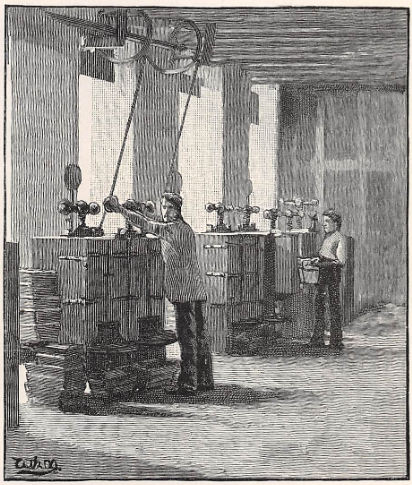
Engraving of hydraulic presses used to obtain cocoa butter. Source: English Illustrated Magazine 1891-1892
3. The First Solid Chocolate Bar (1847)
Paradoxically, the commercial success of Van Houten's defatted cocoa powder generated a massive surplus of cocoa butter in the main industrial regions of Europe. This vegetable fat, characterized by marked crystalline polymorphism and a thermodynamically very narrow melting point (between 32 °C and 35 °C), went from being considered a pressing residue to becoming the fundamental link for a new engineering of confectionery textures.
In 1847, the British manufacturing firm J.S. Fry & Sons, established in Bristol and technologically led by engineer and entrepreneur Joseph Fry, capitalized on the availability of this lipid surplus. Joseph Fry developed a formulation and mechanical processing method that completely inverted the nature of the continuous phase of the chocolate matrix.
The advancement consisted of obviating the use of an aqueous vehicle and operating directly on the solid and fat phases while hot:
Inversion of rheological phases: Instead of grinding the cocoa to disperse it in water, the Fry factory took the refined cocoa liquor (which contained its solids and native fat) and volumetrically recombined it with additional proportions of pure cocoa butter and a high percentage of finely ground crystalline sucrose.
Capillarity and coating: The exogenous addition of cocoa butter increased the volume of the continuous liquid phase at temperatures above 40 °C. This drastically decreased the plastic viscosity and the yield stress of the mass, allowing the fluid lipid to completely coat the hydrophilic surface of the sugar crystals and the non-fat cocoa particles.
Structural fixation by molding: The resulting mass, highly malleable and fluid under thermal shear, possessed the necessary rheological properties to be uniformly poured into casting matrices or metal molds. By subjecting the matrices to controlled cooling, the cocoa butter solidified, mechanically trapping the sugars and solids within a rigid lipid framework.
This milestone officially marked the birth of the first commercial solid chocolate bar, a product specifically designed to be chewed and melted in the oral cavity ("eating chocolate"), forever unlinking it from its strictly drinkable use and facilitating its logistical storage, large-scale transport, and preservation against water activity ($a_w$) as it is an intermediate-low moisture food.
Subsequent Evolution: From the Granule to Mechanical Conching
Despite the success of the 1847 bar, the J.S. Fry & Sons tablets presented a deficient organoleptic texture by current standards: they were substantially gritty, dry, and crunchy to the palate because the rollers of the time failed to reduce the particle size below 60 microns, exceeding the perception threshold of the mechanoreceptors of the tongue.
The definitive solution to this physico-mechanical challenge arrived in 1879 with the invention of the Conching process by the Swiss industrialist Rodolphe Lindt. Conching is a unit operation of agitation, shearing, and mechanical aeration that subjects the chocolate mass to intensive work at controlled temperatures (between 50 °C for milk chocolates and up to 80 °C for dark chocolates) for prolonged periods.
The fundamentals that justify the implementation of conching in the value chain encompass:
Deagglomeration and particle size reduction: Frictional forces break the aggregates of sugar and cocoa solids, homogenizing the particle size distribution below 20 to 25 microns. This completely eliminates the gritty sensation in the mouth.
Desorption of undesired volatile compounds: Continuous aeration facilitates the evaporation of residual water (reducing it below 1%) and the desorption of short-chain organic acids, such as residual acetic acid from inefficient fermentation, notably softening the aromatic profile.
Lipid redistribution: Mechanical energy strips the cocoa butter trapped in the microcavities of the solid particles and transfers it to the free continuous phase. This optimizes the viscosity of the fluid chocolate and ensures that the subsequent tempering process promotes the nucleation of the stable polymorphic Form V ($\beta_V$) crystals, responsible for the surface gloss, the characteristic "snap" upon fracturing the bar, and a homogeneous melting profile upon contact with body temperature.
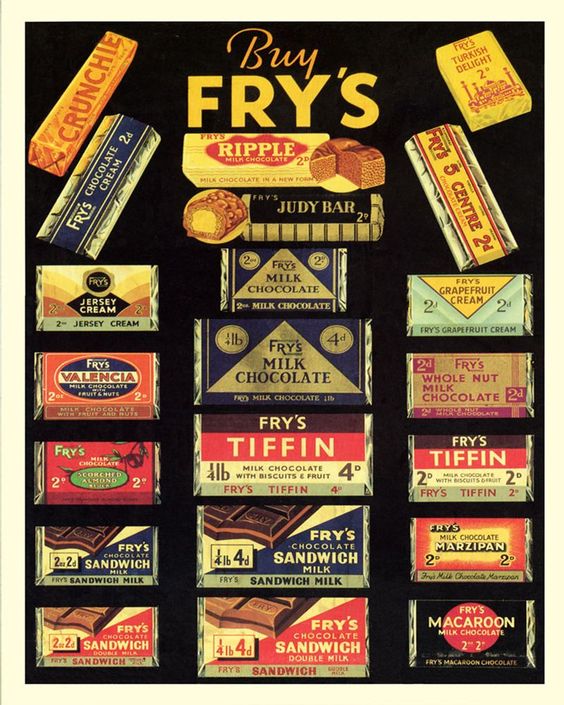
Product bars of J.S. Fry & Sons
4. Bibliographical Sources
Afoakwa, E. O. (2010). Chocolate Science and Technology. Oxford, UK: Wiley-Blackwell. (Comprehensive analysis of the physicochemical principles involved in alkalization, rheology of confectionery fluids, and microscopic particle size distribution).
Christian Aid (2024). Cocoa crisis: How chocolate is feeling the bite of climate change. (Socio-historical and environmental review report documenting the commercial transition from the pre-Hispanic matrix to the molding patents developed in the British 19th century).
Clarence-Smith, W. G. (2000). Cocoa and Chocolate, 1765-1914. London, UK: Routledge. (Specialized historical and economic study on the transition from artisanal to industrial milling, analyzing the impact of compression patents on the global market).
Minifie, B. W. (1989). Chocolate, Cocoa and Confectionery: Science and Technology. (3rd Edition). New York, USA: Van Nostrand Reinhold / Springer. (Fundamental treatise on food engineering focused on the mechanisms of hydraulic pressing, thermal conching, and crystallization of polymorphic triacylglycerols of cocoa butter).