
1. The Institutional Role: The Vital Nexus in the Cocoa Value Chain
Agrarian cooperatives and associations represent the indispensable operational and institutional nexus in the global architecture of the cocoa (Theobroma cacao L.) value chain. In intertropical producing regions, where the land tenure structure is dominated by fragmented smallholdings, farming families face insurmountable systemic barriers on an individual basis: lack of negotiating power, restricted access to agricultural inputs and technologies, and severe market information asymmetries.
Effective associativity serves as the only structural mechanism capable of mitigating the vulnerability of peasant economies to the so-called Living Income Challenge (the challenge of a decent income). By horizontally integrating the atomized supply of hundreds of micro-farms, cooperative organizations consolidate the economies of scale essential for the centralization of post-harvest processing (fermentation and drying), ensuring the production of large volumes of homogeneous beans that consistently comply with the standards demanded by the transnational industry and specialized high-end niches. 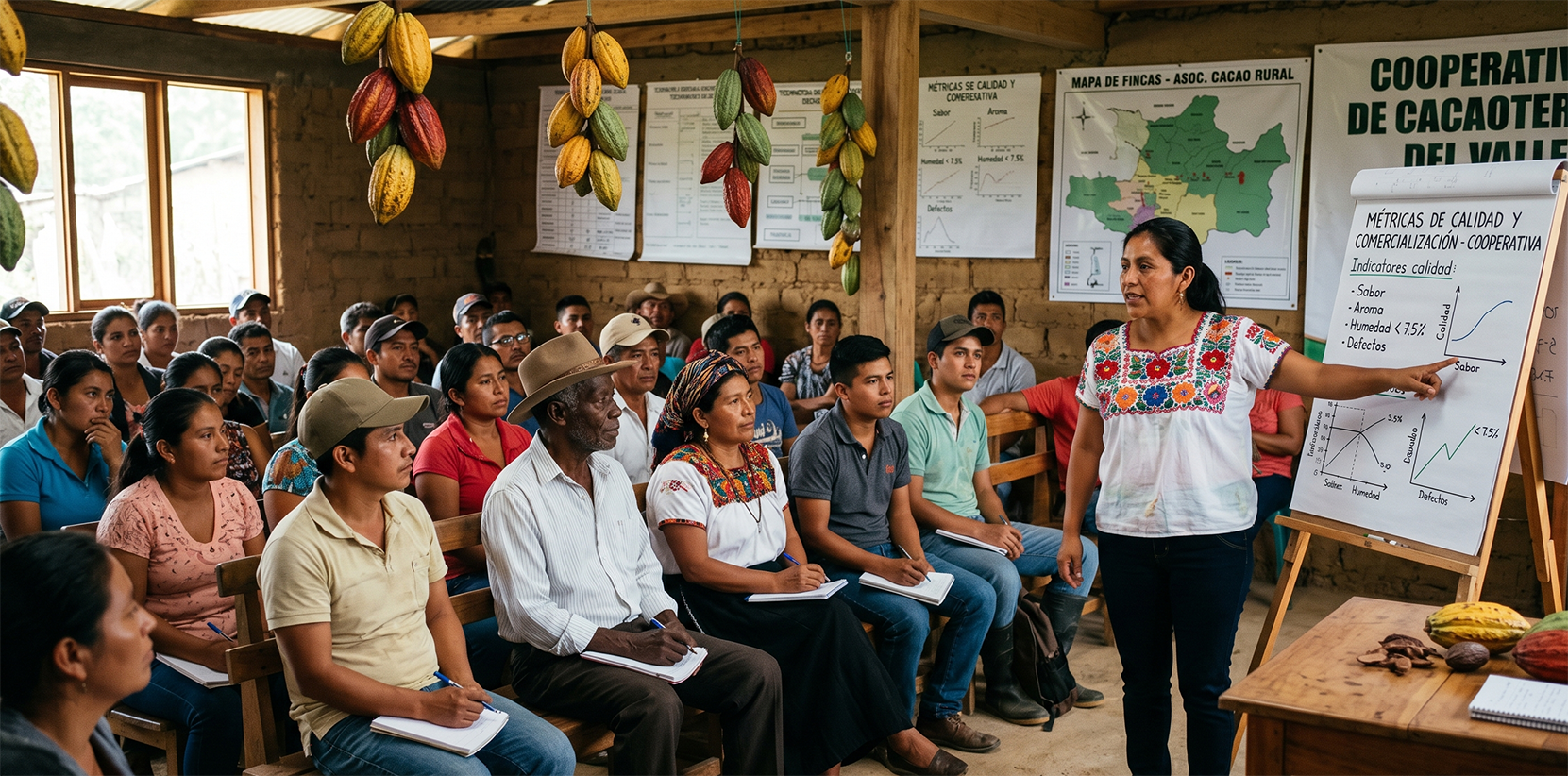
Source: CacaoWorld
2. Democratic Governance Structure: The Pillars of Success and Sustainability
For a cocoa organization to transition from a subsistence scheme to a competitive and resilient business model, it requires the rigorous implementation of a transparent, auditable, and democratic Corporate Governance framework. Governance is not a mere statutory requirement, but the institutional safeguard that prevents conflicts of interest, minimizes moral hazard, attracts external financing, and builds mutual trust between the social base and technical management. An ideal corporate structure is articulated through the following fundamental bodies:
The General Assembly of Members
It represents the supreme and inalienable decision-making body of the cooperative. Operating under the universal cooperative principle of "one member, one vote"—regardless of the volume of capital contributed or the quantity of cocoa delivered—the Assembly ratifies the bylaws, approves the annual financial statements, defines the distribution or reinvestment of surpluses, and democratically elects the members of the boards of directors.
The Board of Directors
It constitutes the collegiate body responsible for strategic direction, the formulation of institutional policies, and the supervision of compliance with long-term objectives. It acts as the critical bridge between the aspirations of the social base and the technical execution of management, assuming the legal and financial responsibility of the organization.
The Supervisory Committee
It exercises the autonomous function of internal oversight and continuous auditing. Its fundamental purpose is to ensure transparency in the use of institutional resources, verify that the actions of the Board of Directors and Management adhere to legal bylaws, and render independent reports to the Assembly, fundamentally mitigating the risk of embezzlement or administrative discretion.
General Management and Operational Areas
They represent the professional executive arm of the organization. General Management coordinates the technical, commercial, and accounting divisions. Within this operational structure, the Internal Control System (ICS) takes on critical relevance, comprising a human and technological team responsible for monitoring farm compliance with certification standards and managing the traceability records essential for international markets.
3. The Cooperative as a Business Academy and Innovation Hub
Successful models demonstrate that sustainable international competitiveness is achieved when the cooperative operates as a continuous "business academy" for the associated small production units. This involves equipping the producer and middle management with technical capabilities that transcend basic agronomy, encompassing three critical fronts of commercial sophistication:
Training Axis Key Components Impact on the Chain Cross-Border Logistics Phytosanitary regulations, incoterms, charter contracts, cold chain management, and humidity control in maritime containers. Mitigation of losses, rejections at destination ports, and contractual penalties. International Negotiation Drafting of international sales contracts, exchange rate risk hedging, and setting benchmark prices on exchanges (London/New York). Commercial disintermediation and capture of a higher percentage of the final value of the chain by the producer. Standardization and Analytical Quality Rigorous post-harvest protocols, physical sampling according to international standards (e.g., Bioversity/CIAT), and organoleptic characterization. Access to premium markets and specialized panels such as Cacao of Excellence.
In the realm of fine flavor quality assurance, corporate governance must provide budgetary support for the implementation of centralized sensory evaluation laboratories. The training of local technicians in advanced tasting protocols allows profiling the specific attributes of the cocoa (breaking down descriptors of acidity, bitterness, fruity, floral, woody, or nutty notes).
Likewise, for organizations oriented towards the biochemical analysis of flavor precursors (sugars, organic acids, and polyphenols) using advanced analytical methodologies such as High-Performance Liquid Chromatography (HPLC), technical management must ensure strict procedural standardization.
4. Associative Commercialization, Ethical Certifications, and Risk Mitigation
An auditable and transparent corporate governance structure constitutes a sine qua non requirement for accessing and maintaining voluntary sustainability certifications, such as Fairtrade (Fairtrade), Organic (USDA Organic / EU), and Rainforest Alliance. These seals demand a level of institutional traceability that only a formalized associative fabric can provide through its Internal Control System (ICS).
Through associative commercialization, the cooperative breaks the traditional schemes of informal local intermediation ("coyotaje"), allowing producers direct access to international minimum support prices and capturing social premiums (Fairtrade premiums). These premiums, far from being distributed in an individualized and atomized manner, are democratically channeled through specialized committees approved by the General Assembly to finance local public goods and strategic collective investments:
Establishment of revolving credit funds for working capital and the renewal of senile plantations.
Investment in shared infrastructure: automated solar drying canopies, noble wood fermentation boxes, and centralized collection centers.
Gender equity programs, technical education scholarships for rural youth, and community health insurance schemes.
Additionally, the contemporary regulatory landscape demands that cooperative governance act as a shield for mitigating international legal risks. Compliance with the European Union Deforestation Regulation (EUDR) requires the cooperative to georeference 100% of its members' plots using satellite polygons, certifying that the beans do not come from deforested lands after the established regulatory thresholds.
Similarly, in the face of global sanitary restrictions regarding metallic contaminants, boards of directors must lead proactive strategies for monitoring heavy metals such as cadmium. This ranges from geostatistical mapping of the association's agricultural soils to channeling specialized analyses via Flame Atomic Absorption Spectrometry (FAAS), guaranteeing compliance with the maximum allowed limits in finished chocolate products and safeguarding the commercial reputation of the cooperative origin.
Bibliographic Sources and Technical References
Alliance of Bioversity International and CIAT. (2024). Guide for the Assessment of Cocoa Quality and Flavour (B. Laliberté, D. Alvarado, N. Villaseñor, Eds.; K. Amaya Vecht, Trans.). Rome, Italy.
Cooperativa Agroindustrial Tocache (CAT). (2021). Manual de cultivo de cacao orgánico y protocolos de certificación interna. San Martín, Perú.
Daymond, A. J., Giraldo Mendez, D., Hadley, P., & Bastide, P. (Eds.). (2022). A Global Guide to Cocoa Farming Systems. International Cocoa Organisation (ICCO), Abidjan, Côte d'Ivoire.
Fairtrade International (FLO). (2023). Sistemas de Gobernanza y Estándares de Comercio Justo para Organizaciones de Pequeños Productores. Bonn, Alemania.
Martínez, I. (2008). Diagnóstico sobre la situación actual del Cacao (Theobroma cacao L.) y perspectivas sobre la producción de Cacao fino de aroma empleando la metodología CADIAC. Escuela Agrícola Panamericana Zamorano, Honduras.
Organismo Internacional Regional de Sanidad Agropecuaria (OIRSA). (2020). Determinación de niveles de cadmio en almendras de cacao (Theobroma cacao) en Centroamérica y República Dominicana. San Salvador, El Salvador.