
1. Origin and Evolution: The Geographical and Cultural Contrast
The study of the botanical center of origin of Theobroma cacao L. reveals a fascinating contrast in the way ancient civilizations interacted with Amazonian versus Mesoamerican biodiversity. Domestication was not a linear event, but rather a process of divergent adaptation.
Amazon (Use of the Aril): In the upper Amazon basin (over 5,300 years ago), cultures such as the Mayo-Chinchipe interacted with an immense genetic diversity. However, their metabolic focus was on the exocarp and mesocarp: the mucilaginous pulp. Given its high concentration of glucose, fructose, and citric acid, the objective was alcoholic fermentation for ceremonial chichas. The cotyledon (the seed), rich in bitter alkaloids, was a discarded byproduct.
Mesoamerica (Seed Domestication): Upon migrating north, the paradigm was reversed. Civilizations such as the Olmec and Maya domesticated the plant with a direct phytochemical focus on the cotyledon. They developed and standardized the first empirical post-harvest processing methods (mass fermentation and solar drying) to degrade astringency and stabilize theobromine, transforming the seed into currency and the basis of xocolatl.
2. The False Commercial Dichotomy vs. The Genomic Reality
One of the greatest contrasts in current cacao agronomy is the gap between the language of the chocolate industry and molecular biology.
The Phenotypic Paradigm (3 Groups)
The industry continues to operate under a classic classification based on pod morphology and cotyledon color:
Criollo: Lack of anthocyanins (white cotyledon), low astringency, short fermentation (2-3 days), and high susceptibility to pathogens.
Forastero: High anthocyanin load (dark purple cotyledon), intense bitterness, prolonged fermentation (5-7 days), and high agronomic hardiness (bulk clones).
Trinitario: Natural hybrid with intermediate characteristics.
The Genomic Paradigm (10 Clusters)
High-resolution genotypic characterization has demystified this division. The use of molecular markers (SSR and next-generation sequencing) demonstrated that grouping Amazonian cacaos under the term "Forastero" makes most of the species' diversity invisible. The modern model contrasts the commercial classification by establishing 10 distinct population clusters (Amelonado, Contamana, Criollo, Curaray, Guayana, Iquitos, Marañón, Nacional, Nanay, Purús). This stratification is vital today for locating quantitative trait loci (QTL) that allow the introgression of resistance to Moniliophthora roreri (Frosty pod rot) or Moniliophthora perniciosa (Witches' broom) without losing aromatic potential.
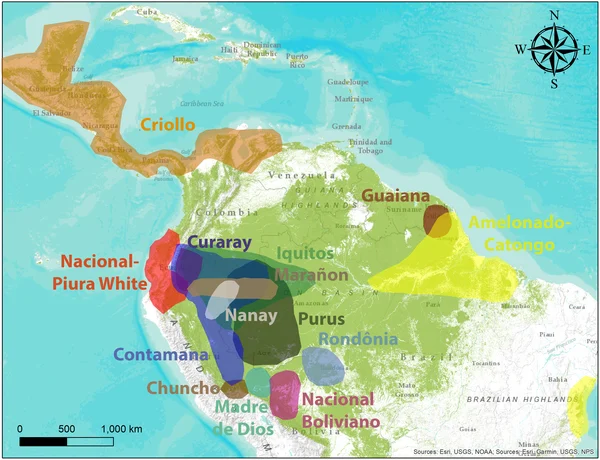
The distribution of cacao genetic groups in their center of origin. Based on Motamayor et al. (2008), Thomas et al. (2012), Zhang et al. (2012), and Arevalo-Gardini et al. (2019) Source: Socio‐ecological benefits of fine‐flavor cacao in its center of origin
3. Metabolic Contrasts in Fermentation: Polyphenols and Organic Acids
At a biochemical level, the expression of quality differs radically depending on the genetic inheritance of the bean, which forces the application of contrasting fermentation curves.
In genotypes derived from the Upper Amazon clusters (traditionally Forasteros), the high initial concentration of polyphenolic compounds (catechins, epicatechins, and anthocyanins) requires a prolonged aerobic fermentation. During this phase, microbial succession transforms the pulp sugars, generating organic acids (predominantly lactic and acetic). The diffusion of these acids into the cotyledon reduces the pH, which activates endoproteases and polyphenol oxidases. In Amazonian cacaos, massive oxidation is required to polymerize phenols into insoluble tannins and reduce astringency.
Conversely, cacaos from the Criollo cluster, lacking the metabolic pathway to synthesize anthocyanins, undergo rapid over-fermentation if subjected to the same times. The excessive accumulation of acetic acid would destroy their floral and fruity precursors, resulting in low-quality cacao with pungent acidity.
4. Quality Evaluation: Visual Test vs. Instrumental Quantification
In quality control and scientific research, the methods for evaluating these metabolic processes present a marked contrast between the physical-visual and the chemical-instrumental.
At the field or collection center level, the industry employs the cut test. Physically, a standardized guillotine is used to cross-section the beans. The operator visually contrasts the level of fermentation by observing the proportion of slaty, violet, or brown beans, as well as internal defects. It is a rapid, qualitative, and structural measurement.
However, in advanced research (metabolomics studies, polyphenol degradation, and calibration curves for flavor profiles), the cut test is insufficient and physical sectioning with a guillotine is irrelevant. For these chemical analytics, it is a prerequisite that the samples are already freeze-dried. Freeze-drying subjects the bean to sub-zero temperatures and vacuum pressure, sublimating the water without applying thermal heat. This instantaneously halts all intracellular enzymatic activity, preserving the profiles of volatile metabolites, alkaloids, and organic acids intact so that they can be extracted and precisely quantified using chromatography techniques (HPLC or GC-MS).
5. Scientific Sources and Technical References
Afoakwa, E. O. (2010). Chocolate Science and Technology. John Wiley & Sons. (Fundamentals of polyphenol degradation).
Bioversity International / Cacao of Excellence (CoEx) (2024). Glossary of terms for the evaluation of cacao beans. Rome.
De Vuyst, L., & Weckx, S. (2016). The cocoa bean fermentation process: from ecosystem analysis to starter culture development. Journal of Applied Microbiology.
Motamayor, J. C., et al. (2008). Geographic and Genetic Population Differentiation of the Amazonian Chocolate Tree (Theobroma cacao L). PLoS ONE, 3(10), e3311.
Schwan, R. F., & Fleet, G. H. (2014). Cocoa and Coffee Fermentations. CRC Press. (Dynamics of organic acid synthesis).